Knowledge-Driven AI for SystemVerilog Assertions
Ships with downloadable RAG-SVA files.
Indian edition ($38): contact ben_cohen@systemverilog.us
Books, papers, and reference code on SystemVerilog Assertions, formal verification, and the RAG-SVA methodology for AI-assisted chip verification.
Former Accellera representative on the SVA committee and member of the PSL committee that produced the PSL LRM.
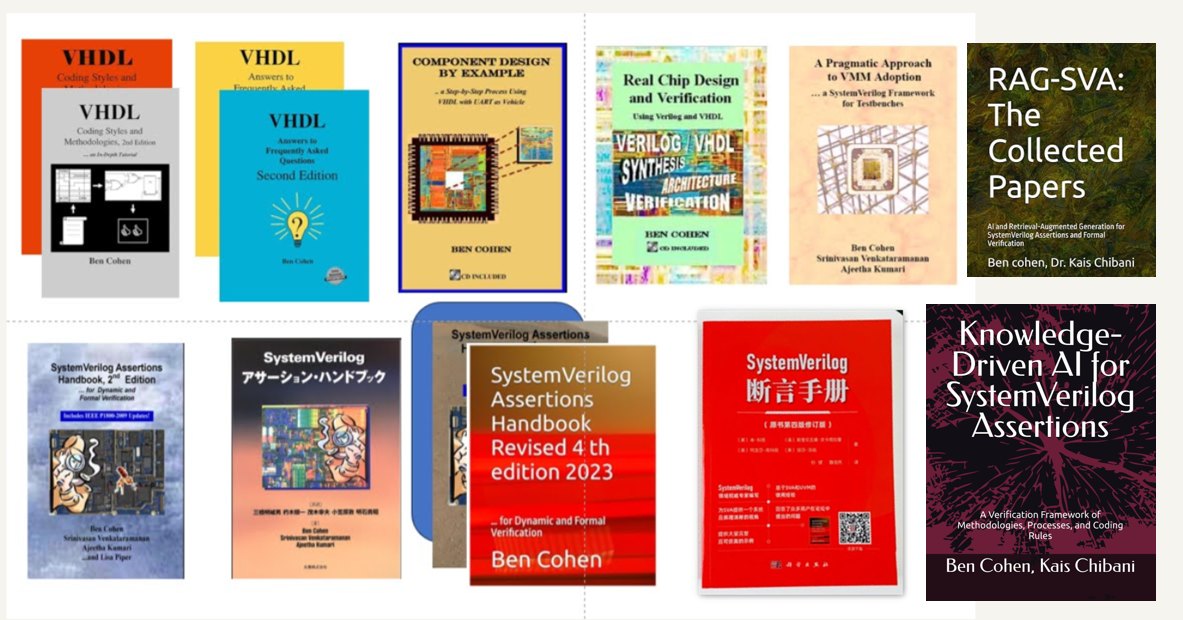
Current titles are available in paper and PDF. Earlier titles include free PDFs and companion code where available.
Ships with downloadable RAG-SVA files.
Indian edition ($38): contact ben_cohen@systemverilog.us
Papers, notes, and reference code, newest first within each topic. Start with Mapping the RAG-SVA Body of Work for a guide to how they fit together.
No papers match that search. Clear the search or choose All.
Author, educator and verification consultant. A leading voice on SystemVerilog Assertions, formal verification and AI-assisted chip verification.
Ben began his career as a design and verification engineer at Hughes Aircraft/Raytheon (1968 to 2000). He worked on proposals, architectures, designs and tests for spacecraft, image-processing and MIMD CPU systems. He has since spent more than 30 years in HDLs and verification through Cohen Publishing.
He served on the PSL committee that produced the PSL LRM, and he was Accellera's representative on the SVA committee that produced the SVA LRM. He has reported numerous SVA bugs across all three major EDA vendors and has written papers on some of them.
He has written eleven books, from VHDL coding styles to Knowledge-Driven AI for SystemVerilog Assertions (2026, with Dr. Kais Chibani). Co-authors on earlier books include Srinivasan Venkataramanan, Ajeetha Kumari and Lisa Piper. Many of the books' insights came from years of questions in user groups. See the Books tab.
Concepts and semantics: the SVA engine as a fork-join model, assertion processing within a time step, immediate assertions, degeneracy, within and intersect, and the req/ack handshake.
Support logic and the always property, the SVA package for dynamic delays and repeats, and SVA in UVM class-based environments.
The 2026 work with Dr. Kais Chibani: correctness lives in an explicit, curated rule corpus rather than in any one AI model.
OVL arbiter, parking-lot controller, async FIFO, req/ack derivations and the CY62256N SRAM, with and without RAG-SVA.
Converting legacy PSL and VHDL environments into SVA that is ready for formal verification, with companion code.
From early experiments with Bing GPT-4 to frame drift in multi-turn LLM interaction.
Technology and clock rate in the assertions, new process nodes, and RAG-RTL with RAG-SVA.
Datasheet to traceable requirements, trusting AI-generated assertions, and how RAG-SVA compares with the big three EDA vendors.
The full list is on the Papers tab.
Good verification starts with clear requirements and a disciplined methodology. It is the garbage-in, garbage-out principle, and it applies equally to a hand-written SVA property and an AI-generated one.